


STD information can help people better understand symptoms, testing, treatment, prevention, and when to talk with a healthcare provider.
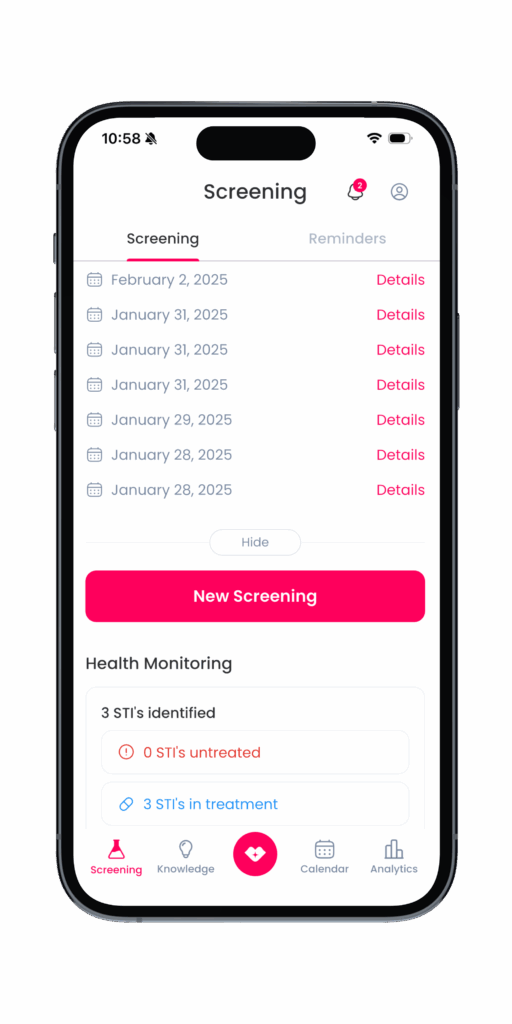
Many people search for STD information when they are worried about symptoms, possible exposure, or how to talk to a partner. KISS helps users access sexual health education, testing reminders, partner alerts, encounter tracking, and safer sex tools in one private app.
Healthcare providers may also use the term STI, which means sexually transmitted infection. Many people use STD and STI interchangeably, so KISS includes both STD and STI education to help users find clear, useful information.
What is an STD?
An STD is commonly understood as an infection or disease that can spread through sexual contact, including vaginal, anal, or oral sex.
Some healthcare sources use the term STI, or sexually transmitted infection, because not every infection causes symptoms or develops into disease. Many people still search for STD information, so KISS uses both STD and STI language to make sexual health education easier to find and understand.
STDs and STIs are common, and having questions about symptoms, testing, or prevention does not mean someone did anything wrong. Better information can help people make better sexual health decisions.
STD information usually includes topics like symptoms, testing, treatment, prevention, partner communication, and follow-up care. Some STDs may cause noticeable symptoms, while others may have no symptoms at all, which is why testing can be important even when someone feels fine.
Common STD symptoms
STD symptoms can vary depending on the infection. Some people may notice symptoms like unusual discharge, sores, bumps, pain, burning when peeing, itching, irritation, rash, swelling, or flu-like symptoms.
However, many STDs do not cause obvious symptoms. CDC says STIs often have no symptoms, so someone may not know they have one. Even without symptoms, infections can still affect health and spread to partners.
That is one reason STD information and testing matter. KISS helps users learn about STD symptoms, testing, prevention, and safer sex habits through the Knowledge section of the app.
When to get STD testing
How often someone should get STD testing depends on their body, partners, sexual activity, symptoms, and possible exposures.
As a general starting point, many sexually active people may consider testing at least once a year. People with new, multiple, or anonymous partners may want to test more often, such as every 3 to 6 months. Some people may also need testing sooner after symptoms, a partner notification, or a possible exposure.
Planned Parenthood explains that STDs are common, many people do not have symptoms, and getting tested is an important part of protecting your health.
KISS helps users turn STD information into action by setting testing reminders, tracking sexual health, and keeping education easier to access.
STD treatment and follow-up care
STD treatment depends on the infection. Some STDs can be treated and cured with medication, while others may be managed with ongoing care, symptom management, prevention tools, or partner communication.
If someone tests positive for an STD, it is important to follow medical guidance, complete treatment as directed, avoid sex when recommended, and notify partners who may need testing or treatment.
KISS helps users connect STD information with follow-up action by supporting partner alerts, testing reminders, encounter tracking, and sexual health education.
STD prevention and safer sex habits
STD prevention is about information, testing, communication, and using the tools available to reduce risk.
Prevention can include condoms, routine STD testing, vaccines when available, PrEP for HIV prevention, DoxyPEP when appropriate, honest partner communication, and knowing what to do after a possible exposure.
KISS helps users build safer sex habits by connecting STD information with testing reminders, partner alerts, encounter tracking, and sexual health education.
STD statistics show why sexual health education matters
STD information matters because sexually transmitted infections are common, often under-discussed, and sometimes present without obvious symptoms.
A few important STD and STI statistics:
- More than 1 million curable STIs are acquired every day worldwide.
- In 2020, there were an estimated 374 million new infections worldwide among people ages 15–49 from chlamydia, gonorrhea, syphilis, and trichomoniasis.
- In 2024, more than 2.2 million cases of chlamydia, gonorrhea, and syphilis were reported in the United States.
- CDC estimates that about 1 in 5 people in the United States had an STI on any given day in 2018.
- HPV is the most common STI in the United States, and CDC says about 85% of people will get an HPV infection in their lifetime.
These numbers show why STD education, testing reminders, partner communication, and prevention tools matter. KISS helps users turn STD information into action through sexual health education, testing reminders, partner alerts, and safer sex tools.
Learn more with KISS
KISS helps users connect STD information with education, reminders, partner alerts, and safer sex tools.
For broader education, users can explore STI information and sexual health education inside KISS.
Users can also learn about common STIs and STDs, including symptoms, testing, and prevention.
For private partner communication, KISS also supports anonymous STI notification through partner alerts.
Download KISS for STD information and sexual health tools
KISS helps users access STD information, learn about symptoms, testing, treatment, and prevention, set testing reminders, send partner alerts, track encounters, and build safer sex habits.
Download KISS on iOS or Android to access sexual health education and private tools for managing your sexual health.
STD stands for sexually transmitted disease. Many healthcare sources also use the term STI, which means sexually transmitted infection. People often use both terms when searching for sexual health information.
Common STD symptoms can include unusual discharge, sores, bumps, itching, burning when peeing, pain, rash, swelling, or flu-like symptoms. Some STDs may have no symptoms.
Many sexually active people may consider STD testing at least once a year. People with new, multiple, or anonymous partners may want to test more often, such as every 3 to 6 months.
Some STDs can be treated and cured with medication. Others may be managed with ongoing medical care, prevention tools, or symptom management.
KISS helps users access STD information, sexual health education, testing reminders, partner alerts, encounter tracking, and safer sex tools in one private app.
No. KISS is not a substitute for medical advice, diagnosis, or treatment. If you have symptoms, test positive, or think you may have been exposed to an STD or STI, consider getting tested and speaking with a healthcare provider.