KISS SEXUAL HEALTH GUIDE
Sexual Health
Sexual health is more than avoiding STIs. It is about knowledge, confidence, communication, consent, pleasure, prevention, and access to care. The World Health Organization defines sexual health as a state of physical, emotional, mental, and social well-being in relation to sexuality. That means sexual health…

01
Quick Sexual Health Facts
02
What Is Sexual Health
03
Why Sexual Health Matters
04
STIs and Sexual Health
The essential guide.
Sexual health is more than avoiding STIs. It is about knowledge, confidence, communication, consent, pleasure, prevention, and access to care.
The World Health Organization defines sexual health as a state of physical, emotional, mental, and social well-being in relation to sexuality. That means sexual health is not just the absence of disease. It also includes safety, respect, autonomy, informed choices, and the ability to have pleasurable sexual experiences free from coercion, discrimination, shame, and violence.
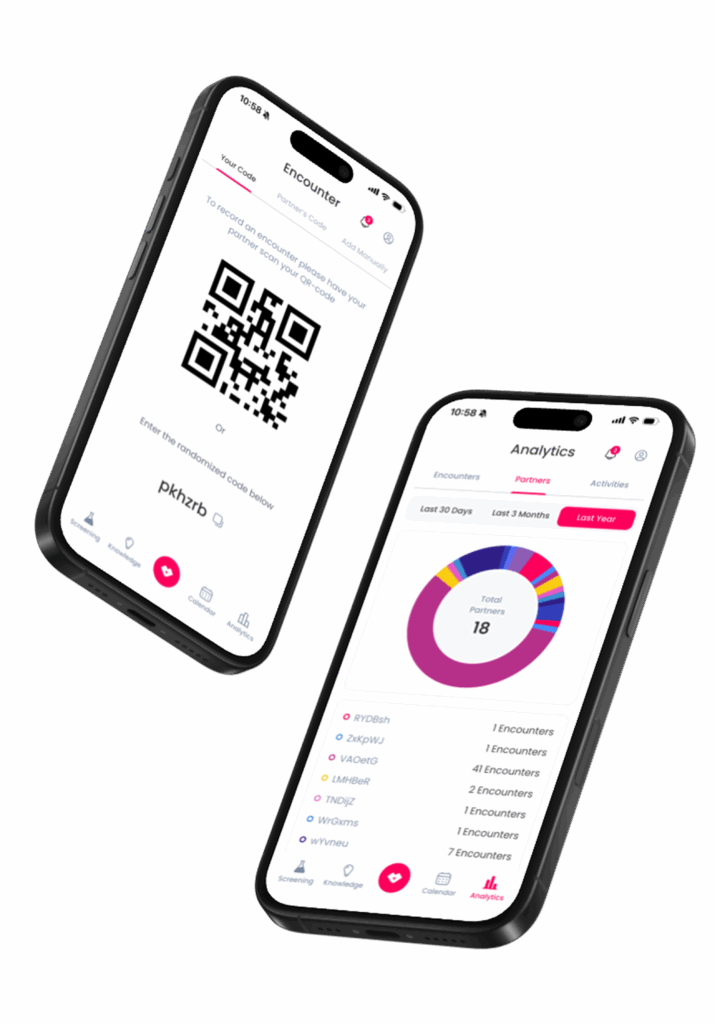
At KISS, we believe sexual health should be private, empowering, and stigma-free. Whether you are dating, hooking up, in a relationship, exploring your identity, or simply trying to stay informed, KISS helps you track encounters, set testing reminders, access STI education, and notify partners anonymously when needed.
Quick Sexual Health Facts
- Sexual health includes physical, emotional, mental, and social well-being.
- STIs are common, and many have no symptoms.
- More than 30 bacteria, viruses, and parasites can be transmitted through sexual contact.
- More than 1 million curable STIs are acquired every day worldwide among people ages 15–49.
- Many STIs are treatable, and some are curable.
- HPV vaccination can prevent most HPV-related cancers.
- Condoms and barriers reduce STI risk, but they do not eliminate all risk.
- Testing is often the only way to know your STI status.
- Consent, communication, and respect are essential parts of sexual health.
- Sexual health is for everyone, regardless of gender, sexuality, relationship status, or sexual experience.
What Is Sexual Health?
Sexual health is not just about preventing infections. It is about having the information, tools, and support to make choices that feel safe, informed, and right for you.
Sexual health can include:
- Understanding STIs and how they spread.
- Knowing when and how often to get tested.
- Using condoms, dental dams, gloves, or other barriers when needed.
- Getting vaccinated for HPV and hepatitis B.
- Understanding PrEP, PEP, and DoxyPEP.
- Talking with partners about testing and boundaries.
- Practicing consent.
- Knowing your body and noticing changes.
- Feeling comfortable seeking care.
- Reducing shame around sexual health.
- Making decisions based on facts, not fear.
Sexual health is personal. The right choices may look different depending on your body, partners, health history, identity, relationship style, and comfort level.
Why Sexual Health Matters
Sexual health affects more than your body. It can impact confidence, relationships, mental health, trust, pleasure, safety, and overall well-being. When people do not have accurate sexual health information, they may delay testing, avoid treatment, misunderstand symptoms, or feel unnecessary shame. That can make it harder to protect themselves and their partners.
Better sexual health education helps people:
- Recognize symptoms earlier.
- Understand that many STIs have no symptoms.
- Get tested before infections spread.
- Start treatment sooner.
- Communicate with partners more clearly.
- Reduce stigma and shame.
- Make safer, more confident decisions.
KISS was created to make these actions easier, more private, and less awkward.
STIs and Sexual Health
STIs, or sexually transmitted infections, are infections that can spread through sexual contact. This can include vaginal sex, anal sex, oral sex, genital skin-to-skin contact, and, in some cases, sharing sex toys.
Some STIs spread through body fluids like semen, vaginal fluids, rectal fluids, or blood. Others can spread through skin-to-skin contact, even when there are no visible symptoms.
Common STIs include:
- Chlamydia
- Gonorrhea
- Syphilis
- Herpes
- HPV
- HIV
- Hepatitis B
- Trichomoniasis
- Mycoplasma genitalium
- Pubic lice
- Scabies
- Molluscum contagiosum
Some STIs are bacterial or parasitic and can often be cured with medication. Others are viral and may not be curable, but they can often be managed with treatment, prevention tools, and regular care.
STIs Often Have No Symptoms
One of the most important things to know about sexual health is that many STIs do not cause obvious symptoms. Someone can have an STI and feel completely fine. They may not have pain, discharge, sores, itching, bumps, or any visible changes. That is why testing matters. Testing is often the only way to know if you have an STI.
Symptoms, when they happen, may include:
- Burning when urinating.
- Unusual discharge.
- Sores, bumps, blisters, or warts.
- Pelvic pain.
- Testicular pain.
- Pain during sex.
- Bleeding between periods.
- Rectal pain, discharge, or bleeding.
- Rash, fever, swollen glands, or flu-like symptoms.
Because symptoms can be mild, hidden, or mistaken for something else, routine testing is an important part of sexual health.
STI Testing
STI testing is normal, responsible, and often simple. What you need depends on your body, partners, symptoms, and types of sex you have. A sexual health provider may recommend urine tests, blood tests, swabs, or physical exams.
Testing may include:
- Chlamydia
- Gonorrhea
- Syphilis
- HIV
- Hepatitis B
- Hepatitis C
- Trichomoniasis
- HPV testing as part of cervical cancer screening
- Herpes testing in certain situations
Not every STI is included in every “standard panel.” If you want a full picture, ask the clinic or provider exactly what is included.
You can ask:
- “Which STIs are included in this test?”
- “Am I being tested for HIV, syphilis, chlamydia, and gonorrhea?”
- “Should I be tested in my throat or rectum based on the sex I have?”
- “Does this panel include herpes?”
- “Do I need HPV screening or a Pap test?”
- “Should I consider PrEP, PEP, or DoxyPEP?”
KISS can help you keep track of testing dates, reminders, and sexual health information privately.
Learn more about STI information and sexual health education inside KISS
How Often Should You Get Tested?
Testing frequency depends on your sexual activity and risk. Some people may only need testing once a year. Others may benefit from testing every 3 to 6 months, especially if they have new partners, multiple partners, anonymous partners, or partners whose STI status is unknown.
You may want to get tested:
- Before having sex with a new partner.
- After a possible STI exposure.
- If a partner tells you they tested positive.
- If you have symptoms.
- If you have multiple or anonymous partners.
- If you stop using condoms with a partner.
- As part of a routine sexual health checkup.
Testing should not be viewed as shameful. It is maintenance, like going to the dentist or checking your blood pressure.
Safer Sex
Safer sex means reducing risk while still allowing space for pleasure, intimacy, and connection.
Safer sex can include:
- Using condoms for vaginal or anal sex.
- Using condoms or dental dams for oral sex.
- Using gloves for manual sex when helpful.
- Using lube to reduce friction and tearing.
- Changing condoms between partners or body parts.
- Cleaning or covering sex toys.
- Avoiding sex when sores, bumps, ulcers, or symptoms are present.
- Getting tested regularly.
- Talking with partners about STI status and prevention.
- Using PrEP when appropriate.
- Considering DoxyPEP when appropriate.
- Getting vaccinated for HPV and hepatitis B.
Condoms and barriers are important, but they are not perfect. Some infections, like HPV, herpes, syphilis, scabies, pubic lice, and molluscum contagiosum, can spread through skin-to-skin contact in areas not fully covered by a condom.
That does not mean condoms do not matter. They still reduce risk for many STIs and are one of the most accessible prevention tools available.
Consent Is Sexual Health
Consent is a core part of sexual health. Consent means all people involved freely agree to what is happening. It should be clear, mutual, informed, and ongoing.
Consent is not pressure. It is not silence. It is not someone giving in because they feel afraid, guilty, intoxicated, manipulated, or unable to say no.
Healthy consent includes:
- Asking before moving forward.
- Respecting boundaries.
- Checking in.
- Accepting “no” without punishment.
- Understanding that consent can change.
- Making space for pleasure and comfort.
- Not assuming someone wants something based on past experiences.
Sexual health is not only about preventing infections. It is also about safety, respect, communication, and autonomy.
Communication With Partners
Talking about sexual health can feel awkward, but it gets easier with practice. You do not have to make the conversation dramatic. You can be direct, calm, and matter-of-fact.
You might say:
- “When was the last time you were tested?”
- “Do you know what you were tested for?”
- “I like to get tested regularly. I’d feel better if we both knew our status.”
- “Do you use PrEP?”
- “Are you comfortable using condoms?”
- “I want us to talk about boundaries before we hook up.”
- “I tested positive for an STI, and I wanted to let you know so you can get tested.”
These conversations are not about blame. They are about care, trust, and informed choices.
KISS helps make partner communication easier with private tools, testing reminders, encounter tracking, and anonymous partner alerts.
HPV and Sexual Health
HPV, short for human papillomavirus, is the most common STI.
There are more than 200 known HPV types, and around 40 can infect the genital area. Some HPV types cause genital warts. Others are considered high-risk because they can cause cancer over time.
HPV can cause cervical, anal, penile, vaginal, vulvar, and throat cancers.
The HPV vaccine is one of the strongest sexual health prevention tools available. In the United States, Gardasil 9 protects against nine HPV types: 6, 11, 16, 18, 31, 33, 45, 52, and 58.
HPV is common, but prevention matters. Vaccination, cervical cancer screening, condoms, and sexual health awareness can all help reduce risk.
Herpes and Sexual Health
Herpes is a common viral STI caused by the herpes simplex virus, usually called HSV.
There are two main types:
HSV-1, which is often associated with oral herpes but can also cause genital herpes.
HSV-2, which is more commonly associated with genital herpes.
Herpes can spread through skin-to-skin contact, including oral, vaginal, and anal sex. It can spread when symptoms are present and, in some cases, when no visible sores are present.
Herpes is not curable, but it is manageable. Antiviral medications can reduce symptoms, shorten outbreaks, and lower the chance of passing herpes to partners.
Having herpes does not mean someone is dirty, irresponsible, or unable to have a healthy sex life. What matters is education, care, communication, and prevention.
PrEP, PEP, and HIV Prevention
HIV prevention is an important part of sexual health. PrEP, short for pre-exposure prophylaxis, is medicine that can reduce the chance of getting HIV when taken as prescribed. PEP, short for post-exposure prophylaxis, is emergency medicine taken after a possible HIV exposure. It must be started quickly, usually within 72 hours.
People may want to ask a provider about PrEP if they have partners with HIV, have multiple partners, have anonymous partners, do not always use condoms, or have recently had certain STIs.
PrEP and PEP do not prevent all STIs just HIV, so testing, condoms, and other prevention tools may still be important.
DoxyPEP
DoxyPEP, short for doxycycline post-exposure prophylaxis, is a newer STI prevention strategy for some people.
It involves taking doxycycline after sex to reduce the chance of certain bacterial STIs, including syphilis, chlamydia, and gonorrhea.
DoxyPEP is not for everyone, and it should be discussed with a healthcare provider. It is also not a replacement for testing, condoms, vaccination, or medical care.
If you are at higher risk for STIs or have had recent bacterial STIs, ask a sexual health provider whether DoxyPEP may be appropriate for you.
Vaccines and Sexual Health
Vaccines can prevent some infections that are spread sexually or connected to sexual health.
Important vaccines to ask about include:
HPV vaccine
Hepatitis B vaccine
Hepatitis A vaccine for some people
Mpox vaccine for some people
Vaccination is prevention. It can reduce the risk of certain infections and, in the case of HPV, help prevent several types of cancer.
Sexual Health for LGBTQ+ People
Sexual health should be inclusive, affirming, and relevant to real people’s lives.
LGBTQ+ people may face barriers to sexual health care, including stigma, discrimination, lack of provider knowledge, fear of judgment, and limited access to affirming clinics.
KISS was built with privacy, anonymity, and stigma reduction at the center. Sexual health tools should work for everyone, including LGBTQ+ people, people with multiple partners, people dating casually, people in relationships, and people who simply want better control over their sexual health.
You deserve care that respects your identity, your body, your privacy, and your choices.
Sexual Health and Privacy
Sexual health is personal. Many people avoid testing, treatment, or partner conversations because they are afraid of being judged, exposed, or shamed. Privacy matters.
KISS helps users manage sexual health more privately by allowing them to:
- Track encounters.
- Set testing reminders.
- Set medication reminders.
- Access sexual health education.
- Keep sexual health information organized.
- Notify partners anonymously when needed.
- Use the app without requiring a name on their profile.
Sexual health tools should make care easier, not more embarrassing.
Reducing STI Stigma
STI stigma does not prevent STIs. It prevents conversations, testing, treatment, and honesty. Many STIs are common. Many have no symptoms. Many are treatable. Some are curable. Others are manageable with medication and care. Having an STI does not make someone dirty. It does not define their worth. It does not mean they are irresponsible.
A better sexual health culture is based on:
- Facts over fear.
- Testing over guessing.
- Care over blame.
- Communication over shame.
- Prevention over judgment.
- Privacy over exposure.
KISS exists to help build that culture.
When to See a Healthcare Provider
Consider seeing a healthcare provider if you:
- Have symptoms of an STI.
- Think you were exposed to an STI.
- Have a partner who tested positive.
- Need routine STI testing.
- Want to start PrEP.
- Need emergency PEP after possible HIV exposure.
- Are interested in DoxyPEP.
- Have questions about HPV vaccination.
- Have abnormal bleeding, pain, sores, discharge, bumps, or rashes.
- Need cervical cancer screening.
- Are unsure what testing you need.
KISS can help you stay organized, but it does not replace professional medical care.
How KISS Helps You Manage Sexual Health
KISS is a private, sex-positive app designed to help you manage sexual health with more confidence.
With KISS, you can:
- Track encounters privately.
- Record STI screenings.
- Set testing reminders.
- Set medication reminders.
- Access STI and sexual health education.
- Notify partners anonymously.
- Reduce awkwardness around partner communication.
- Stay informed without sharing unnecessary personal information.
KISS puts knowledge, information, and safer sex tools in one place.
Sexual Health FAQ
What does sexual health mean?
Sexual health means physical, emotional, mental, and social well-being in relation to sexuality. It includes safety, respect, consent, pleasure, prevention, communication, and access to care.
Is sexual health only about STIs?
No. STIs are one part of sexual health, but sexual health also includes consent, communication, relationships, pleasure, identity, privacy, reproductive health, and emotional well-being.
How do I know if I have an STI?
Testing is the only way to know for sure for many STIs. Many STIs have no symptoms, so routine testing is important if you are sexually active.
How often should I get tested?
It depends on your sexual activity and risk. Some people test once a year. Others test every 3 to 6 months, especially if they have new, multiple, or anonymous partners.
Do condoms prevent all STIs?
No. Condoms reduce risk, but they do not prevent every STI. Some infections can spread through skin-to-skin contact in areas not covered by a condom.
What STIs can spread through skin-to-skin contact?
HPV, herpes, syphilis, scabies, pubic lice, and molluscum contagiosum can spread through skin-to-skin contact.
What vaccines are important for sexual health?
The HPV vaccine and hepatitis B vaccine are two important vaccines connected to sexual health. Some people may also benefit from hepatitis A or mpox vaccination.
What is PrEP?
PrEP is medication that helps prevent HIV when taken as prescribed. It does not prevent other STIs.
What is DoxyPEP?
DoxyPEP is doxycycline taken after sex to reduce the risk of some bacterial STIs in certain people. It should be discussed with a healthcare provider.
Can KISS diagnose an STI?
No. KISS does not diagnose, treat, or replace medical care. KISS helps users track sexual health, set reminders, access education, and notify partners anonymously when needed.
Is KISS private?
Yes. Privacy and anonymity are central to KISS. KISS is designed to help users manage STI alerts, testing reminders, encounter tracking, and safer sex habits without unnecessary personal information.
Trusted Sexual Health Resources
For additional sexual health information, explore these trusted resources:
World Health Organization: Sexual Health
World Health Organization: Sexually Transmitted Infections
American Sexual Health Association: Sexual Health
American Sexual Health Association: STDs A to Z
Planned Parenthood: STD Testing
CDC: Sexually Transmitted Infections
Take Control of Your Sexual Health
Sexual health should not be confusing, shame-filled, or hard to manage.
KISS helps you track encounters, set reminders, access sexual health education, and notify partners anonymously when needed.
Knowledge. Information. Safer Sex.